
Application Guide
Virus & Gene Therapy with the ARC — measurement workflows, data examples, and method guidance.
What to Measure
Three critical quality attributes for viral vector characterization
From cell culture to final formulation, viral vectors must be accurately characterized for dose, potency, and purity. Traditional methods are slow, indirect, or fail in the presence of process-related impurities.
Quality Attribute 01
Fast & easy: virus size and concentration with MRPS

MRPS measurement of human adenovirus 5 (hAd5) — three technical replicates. Mean diameter ~85 nm with high repeatability across runs.
The challenge
Viruses are produced in complex biological systems alongside process-related impurities — cell debris, proteins, and extracellular vesicles. Live titer assays take days and require susceptible cell lines. Indirect methods like ELISA and SP-IRIS don’t yield accurate particle concentration in mixed matrices.
With MRPS
MRPS detects each particle electrically as it transits a microfluidic constriction. Signal is proportional to particle volume regardless of refractive index or sample complexity. Results in minutes directly from cell culture supernatant — no dilution optimization, no reference standard.
Quality Attribute 02
Virus purity and titer in a single measurement
The challenge
Viral vector preparations contain both genome-containing (full) and genome-free (empty) particles. Separating their quantification traditionally requires orthogonal assays on separate instruments — adding time, sample consumption, and opportunities for error.
With F-MRPS
The ARC adds fluorescence detection to MRPS. A membrane-permeable intercalating dye labels nucleic acid inside intact particles. Size, total concentration, and fluorescent (full) particle fraction are measured simultaneously — in a single 3 µL injection.
Example result — hAd5
Intact (full) hAd5 detected at 5.4 × 10&sup9; particles/mL — representing 64% of all particles in the measured size range.
Sample: hAd5 mixed with a broad extracellular vesicle background. Single measurement, no pre-processing.

hAd5 stained with a nucleic acid intercalating dye. Fluorescence-positive particles (intact virions) quantified as a fraction of the total size distribution in one run.
Method Comparison
How F-MRPS compares for viral vector characterization
Virus characterization demands accuracy in the presence of process impurities. DLS and NTA were designed for cleaner samples — and show it.

Supported Viruses
Quantify a broad range of viruses with F-MRPS
The ARC has been validated across a wide range of viral vectors and virus types. Don’t see yours? Reach out — we’re continuously expanding the list.

Resources
Application notes and technical guides
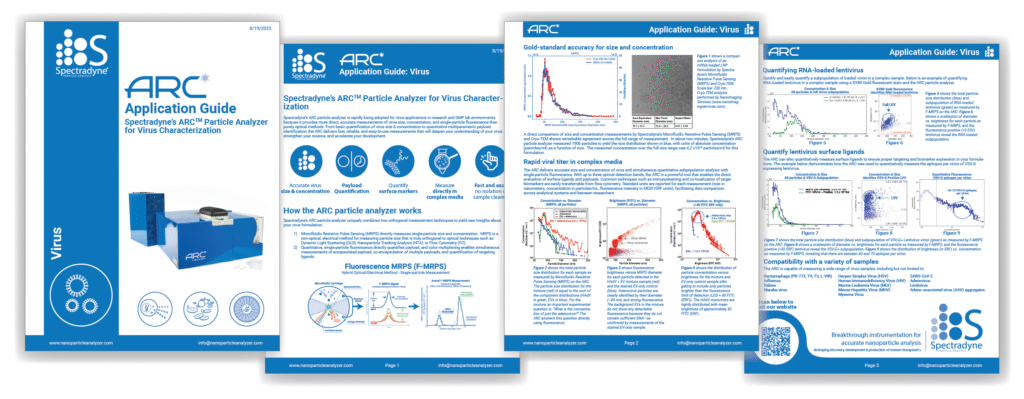
Application Guide
Virus & Gene Therapy with the ARC
Step-by-step measurement protocols, data examples for viral titer and purity, and guidance for working in complex biological matrices.
Download Guide →Ready to measure your viral vectors?
Submit a sample for a free measurement, or schedule a live demonstration with one of our applications scientists.